
You might find yourself checking the weather forecast during a bad storm, only to realize your home lacks the basics if the power cuts out. A sudden utility outage or a severe weather warning quickly shows where your home supplies fall short. When that happens, people start searching for the best prepper gear to buy before normal supply chains face delays.
Choosing these items isn’t simple because gear generally falls into two opposite camps. You have to balance quick grab-and-go portability against heavy, long-term home supplies. This article helps you settle which tools belong in your home based on what each item actually does.
As an Amazon Associate, we earn from qualifying purchases. This post contains affiliate links – if you buy through them, we may earn a commission at no extra cost to you.
1. Ready America 70280 Emergency 2-Person 3-Day Survival Backpack

Right for: Two people wanting basic evacuation supplies in one grab bag.
This kit provides 72 hours of emergency support for two people with 4,800 calories across two food bars and 12 drinking water pouches. The listing includes two ponchos, two blankets, a 33-piece first aid kit, dust masks, nitrile gloves, two 12-hour lightsticks, and a whistle. It packs everything inside a lightweight backpack meant for earthquakes, hurricanes, and office or vehicle storage.
If you must leave your home on foot or by car in a hurry, having your basic shelter, water, and food sealed in one bag saves valuable minutes. The included food doesn’t require heating or extra tools to eat, which keeps things simple when utilities aren’t running. Because it holds a limited supply of food and water, this pack isn’t meant for extended stays beyond a short-term emergency.
What works:
- Includes 4,800 total emergency calories
- Contains 12 sealed water pouches
- Lightweight backpack keeps items organized
- Packed with 33-piece medical kit
Where it gives ground:
- Covers only three days of food
- Lightsticks provide one-time temporary lighting
Skip it if: you need an extended emergency supply for a larger group.
2. TacPreps Bug Out Bag Backpack Survival Kit

Right for: Anyone who needs outdoor survival tools alongside emergency rations.
The TacPreps kit uses a 45-liter tactical backpack made from water-resistant fabric to hold supplies for a solo user or a small pair for a short-term emergency. It includes freeze-dried rations, food bars, a portable stove, compact cookware, a water filter, and 12 water pouches. For outdoor shelter and field tasks, the pack adds an emergency tent, two bivy bags, a solar and hand-crank radio, two headlamps, 30 feet of paracord, a folding saw, and a multitool.
This setup helps when you find yourself forced to shelter outside or set up camp along an evacuation route. Having a portable stove and cookware means you can prepare hot food, provided you carry fuel, while the water filter helps you clean water from natural outdoor streams. It requires extra space and effort to manage all the individual tools compared to simpler grab-and-go bags.
What works:
- Spacious 45L water-resistant tactical pack
- Includes portable stove and cookware
- Features emergency tent and bivies
- Solar and hand-crank radio included
Where it gives ground:
- Many separate tools increase total bulk
- Requires outdoor preparation to use cookware
Skip it if: you want a basic kit without extra field tools and hardware.
3. 4Patriots 4-Week Survival Food Kit

Right for: Households building a multi-week home emergency food reserve.
This emergency supply contains 192 servings across 11 recipes, such as sweet oatmeal and mac & cheese, delivering an average of 36,480 total calories. The food is sealed in triple-layer Mylar packaging with high-capacity oxygen absorbers to support a shelf life of up to 25 years when stored below 75°F. Meals are made by adding boiling water and simmering for about 15 minutes.
On a normal day during a prolonged winter storm or supply chain delay, this supply keeps you fed right from your own kitchen pantry. You won’t have to rotate stock every few months since the Mylar pouches are made to sit untouched for decades in cool, dry conditions. However, preparing these meals requires clean boiling water, so you can’t eat them straight out of the pouch without heat.
What works:
- Delivers 192 total meal servings
- Rated for 25-year shelf life
- Triple-layer Mylar blocks moisture
- Provides 11 different meal recipes
Where it gives ground:
- Requires boiling water to prepare
- Averages roughly 1,302 calories per day
Skip it if: you need meals that can be consumed immediately without heating water.
4. LifeStraw Personal Water Filter

Right for: Hikers and travelers needing ultralight personal water purification.
The LifeStraw is a personal membrane microfilter weighing less than two ounces that removes 99.999999% of bacteria, 99.999% of parasites, and 99.999% of microplastics, silt, and sand. It cleans up to 1,000 gallons of drinking water over its lifespan and has an unlimited shelf life when stored dry. The filter operates directly from natural water sources without chemicals, batteries, or moving mechanical parts.
Tossing this tiny tube into a backpack side pocket gives you a reliable way to drink from creeks, rivers, or lakes if your tap water shuts off. It’s so light that carrying it won’t slow you down during an unexpected on-foot evacuation. Keep in mind that you must drink straight from the source through the straw, as it doesn’t store water for later use.
What works:
- Weighs less than two ounces
- Cleans up to 1,000 gallons
- Removes bacteria, parasites, and microplastics
- Unlimited shelf life when dry
Where it gives ground:
- Doesn’t hold or store water
- Requires drinking directly from source
Skip it if: you need to store clean drinking water for your entire family.
5. waterBOB Bathtub Emergency Water Storage Bladder Up To 100 Gallon

Right for: Homeowners wanting to store bulk tap water before a storm.
This heavy-duty, BPA-free plastic bladder turns a standard household bathtub into a clean holding reservoir that stores up to 100 gallons of fresh water. It connects directly to your tub faucet using an included fill sock, filling completely in about 20 minutes before a hurricane or municipal disruption hits. The sealed liner keeps drinking water fresh for up to 16 weeks and includes a siphon hand pump for dispensing.
When severe weather approaches, setting this up lets you keep days of drinking, cooking, and sanitation water inside your bathroom without buying dozens of plastic bottles. The sealed construction prevents dust, soap residue, and bathroom contaminants from reaching the water supply while it sits in the tub. It does require advance warning to fill from the tap, so it won’t help after municipal water lines have already shut down.
What works:
- Holds up to 100 gallons
- Keeps water fresh 16 weeks
- Includes siphon hand pump
- Fills in about 20 minutes
Where it gives ground:
- Requires working tap water beforehand
- Ties up the household bathtub
Skip it if: you need portable water containers that you can carry in an evacuation.
6. RunningSnail Hand Crank Radio with Flashlight

Right for: Anyone needing weather alerts, emergency power, and lighting during blackouts.
The RunningSnail radio receives AM, FM, and NOAA weather alerts using a retractable antenna to boost weak signals. It features a built-in 2000mAh rechargeable battery that doubles as a USB emergency power bank for mobile phones, alongside an integrated 1-watt LED flashlight. The unit recharges via solar panel, a manual hand crank, or its internal battery, weighing just 0.5 pounds with dimensions of 5 by 1.8 by 2.4 inches.
During an unexpected power grid failure, this radio keeps you updated on local emergency broadcasts without relying on household wall outlets. The hand crank ensures you can always generate just enough power to check storm warnings or give a dead phone a brief boost. Because the battery holds 2000mAh, it provides emergency top-offs rather than complete recharges for modern smartphones.
What works:
- Three charging modes including crank
- Receives NOAA real-time weather alerts
- Built-in 2000mAh USB power bank
- Compact half-pound portable frame
Where it gives ground:
- 2000mAh battery provides limited phone charge
- Hand cranking requires physical effort
Skip it if: you need high-capacity power banks to run large household electronics.
7. Texas Bushcraft Ferro Rod

Right for: Survivalists needing a weatherproof tool to ignite emergency fires.
This fire starter uses a 3/8-inch thick ferrocerium rod designed to throw sparks at 5,000°F to light tinder, cattail seed, and plant fuzz. It’s rated for over 15,000 strikes and is impervious to rain, wind, and water, unlike standard safety matches. The rod features a hardwood handle and comes tied with a 48-inch braided paracord lanyard to a multi-tool striker that includes a ruler, map scale, wrench, and bottle opener.
If you’re stuck outdoors in soaking wet conditions, this rod creates sparks regardless of dampness or freezing cold air. It fits neatly into a jacket pocket or glove compartment so you always have a spark source ready for an emergency camp stove or campfire. However, unlike a standard disposable lighter, producing a flame with a ferro rod requires dry tinder and some practical striking practice.
What works:
- Delivers 5,000°F sparks
- Rated for 15,000+ total strikes
- Unaffected by water and wind
- Includes 48-inch paracord lanyard
Where it gives ground:
- Requires tinder to catch sparks
- Needs practice to strike effectively
Skip it if: you prefer the push-button ease of standard butane lighters.
8. Gardeners Basics Survival Seed Vault Kit

Right for: Gardeners planning an emergency backyard food source for future seasons.
The kit provides over 16,000 non-GMO, open-pollinated heirloom vegetable seeds split across 35 individual varieties, including leafy greens, beans, root vegetables, and tomatoes. Every variety comes in its own labeled paper seed packet along with 35 plant markers for organization in garden beds or containers. The entire collection comes packed inside a resealable Mylar storage bag designed to keep seeds protected in cool, dry conditions.
Putting this vault in your home storage ensures you have seeds ready to grow fresh produce if food supply disruptions drag on for months. Because the seeds are open-pollinated heirlooms, you can harvest and save the seeds from your mature plants to replant in subsequent years. This kit won’t feed you during an immediate emergency, as vegetables take months of sunlight, water, and labor to grow.
What works:
- Contains 16,000+ heirloom seeds
- Offers 35 vegetable varieties
- Resealable Mylar bag protects packets
- Open-pollinated for future seed saving
Where it gives ground:
- Takes months to produce food
- Requires garden space and soil
Skip it if: you need immediate, ready-to-eat rations for short-term power blackouts.
9. EVERLIT 250 Pcs Survival First Aid Kit
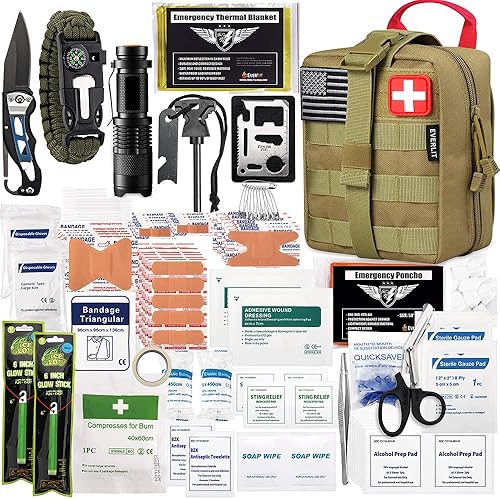
Right for: Anyone who wants a dedicated medical kit built into a rugged pouch.
The EVERLIT kit contains 250 pieces combining medical first aid supplies with outdoor survival gear, all packed into a water-resistant 1000D nylon MOLLE pouch. The bag measures 8 by 6.5 by 5 inches, offering three internal compartments and exterior straps to hook onto vests or bags. In addition to bandages and wound pads, it includes a tactical flashlight, multi-function paracord bracelet, knife, glow sticks, rain poncho, and space blanket.
Having this pouch mounted to your car trunk or bug-out pack means minor cuts, scrapes, and abrasions won’t get infected during an emergency. The tough nylon fabric prevents medical supplies from getting crushed or soaked when tossed into rough terrain or vehicle storage. The compact dimensions mean the pouch holds limited supplies, so it won’t handle major surgical trauma or multiple injured people.
What works:
- Tough 1000D water-resistant MOLLE pouch
- Includes 250 medical and survival pieces
- Compact two-pound total carry weight
- Three organized internal compartments
Where it gives ground:
- Best suited for minor first aid
- Compact pouch limits extra storage
Skip it if: you need professional trauma equipment for severe emergency injuries.
10. Emergency 2-Person Orange & Gray Survival Tent with Whistle &

Right for: Evacuees needing an ultra-compact wind and water shelter for unexpected storms.
This emergency tube tent provides coverage for a pair of users using thermal, wind-resistant, and water-resistant material designed to retain body heat during severe weather. It pitches between trees using an included drawstring cord with a nylon core, or it can be wrapped around you directly as an emergency sleeping bag. The lightweight pack is sized to fit inside a hiking pack, earthquake kit, or vehicle go-bag without adding heavy bulk.
When forced to spend an unexpected night outside during an evacuation, this tube tent sets up in minutes to block wind and rain. Placing pebbles or gear along the inside floor edges helps secure the shelter if strong gusts kick up. Because it uses a minimalist tube design without poles, you must find two sturdy anchor points or wrap it around your body.
What works:
- Wind- and water-resistant thermal material
- Simple tube tent design
- Includes nylon-core drawstring cord
- Functions as emergency sleeping bag
Where it gives ground:
- Requires trees or stakes to erect
- Basic tube lacks integrated floor poles
Skip it if: you want a freestanding, framed camping tent with rigid poles.
Also Worth Considering
- Ready Supply-Survival Meals Long Shelf: A 120-serving freeze-dried entree bucket designed for disaster preparedness and outdoor trips where you want a sturdy plastic container holding long-lasting meals.
- Collapsible Outdoor Home Emergency Light: A four-pack of collapsible, lightweight lanterns that recharge via solar and USB to illuminate multiple rooms or campsites during storm power outages.
- Sucrain Pocket Chainsaw: A 24-inch folding hand chain saw with 11 cutting teeth and paracord handles, designed for clearing fallen tree limbs and cutting firewood on outdoor treks.
How to Think Before You Choose
Immediate Caloric Access Versus Long-Term Storage
Pre-made ration bars provide immediate calories without requiring fuel, pots, or water, making them practical for quick car evacuations. In contrast, large freeze-dried pouches offer better nutritional variety and can last decades, but they’re useless if you can’t boil water. If your priority is handling a 72-hour utility cut, lean toward ready-to-eat rations. Check your pantry right now to see if you have a reliable way to boil water during a power failure.
Bulk Water Holding Versus Field Filtration
Bulk tub liners store vast amounts of household tap water in place, which protects an entire family during municipal outages. However, water filters let you move on foot and drink from natural creeks without carrying heavy liquid weight. Most suburban households facing storms should lean toward bulk home storage first, as guided by the Ready.gov evacuation safety guidelines. Measure your bathtub’s drain fit and faucet clearance to verify you have space for bulk bladders.
All-in-One Bags Versus Individual Specialty Tools
Pre-packed survival backpacks provide immediate readiness because every basic necessity comes organized in a single grab bag. Specialty standalone tools, like dedicated first aid pouches and thick ferrocerium rods, provide higher durability and repeated utility at the cost of packing complexity. Beginners benefit most from all-in-one bags to cover the basics immediately. Count how many functional flashlights and medical bandages you currently have ready before assembling individual gear pieces.
Who Should Skip These Altogether
- Anyone only dealing with minor ten-minute grid blips can rely on simple household flashlights instead of survival gear.
- Experienced campers who already own lightweight tents, backpacking stoves, and water purifiers already have equivalent tools in their closets.
- Residents living in high-rise buildings without bathtubs or outdoor spaces will find large water bladders and fire steels hard to use.
- Casual buyers who tuck gear into deep closets and never inspect expiration dates or practice using the tools won’t benefit from complex kits.
The Ready America Survival Backpack is the right choice for most people who need a basic, quick-grab evacuation kit, while the TacPreps Bug Out Bag handles the harder case of extended outdoor shelter. Check your household emergency exit plan today to decide whether you’re staying in place or packing to move.
Related guides
Frequently Asked Questions
What utility supplies do these emergency kits need to work?
Most survival kits work straight out of the box, but cooking setups and freeze-dried meals require clean water and a dependable heat source. If your emergency pack contains dehydrated meals, ensure you also keep a compact camp stove, fuel canisters, and matches stored alongside it.
How much maintenance do survival items require over time?
Emergency gear requires scheduled inspections once or twice every year to check expiration dates on food bars, water rations, and first aid ointments. You should also unfold stored tents, inspect seals on seed bags, and cycle the rechargeable batteries on radios so they don’t degrade in dark closets.
What component usually fails or expires first in preparedness kits?
Sealed water pouches and food bars carry fixed manufacturer expiration dates, whereas items like ferrocerium rods, steel multitools, and manual water filters will last for many years without spoiling.
Is a simple three-day backpack enough for most common home emergencies?
Yes, a basic 72-hour kit covers the typical window needed for emergency rescue crews or local utility providers to restore vital services after severe weather strikes. If you live in remote rural areas prone to blocked roads, however, you’ll eventually want to supplement it with larger bulk food stores.
What details should you verify before buying bulk water storage gear?
Before ordering a bathtub bladder, check your tub’s interior shape and make sure your faucet doesn’t use non-standard fixtures that prevent the fill sock from attaching securely. You should also confirm that your bathroom floor and tub structure can handle hundreds of pounds of water weight when full.
Final Thoughts
Building your emergency kit doesn’t have to happen all at once. Start by picking up a few extra gallons of water or a reliable flashlight during your next grocery trip. You’ll feel much more confident knowing you’re ready for whatever comes your way, so don’t wait until the clouds turn dark.