
As an Amazon Associate, we earn from qualifying purchases. This post contains affiliate links – if you buy through them, we may earn a commission at no extra cost to you.
Finding the best neoprene socks for fly fishing comes down to how and where you step into the river. There isn’t one universal pair that beats every other option because your boots, water temperatures, and gravel issues dictate what actually works. Some anglers need fold-over guards that lock out grit, while others want close-fitting warmth inside breathable waders or standard wading shoes. The 8 Fans Neoprene Wading Socks suit anglers who fight gravel sneaking into their boots, while the STORMR Neoprene Fishing Socks split off for those who face cold water and want glued seams with micro-fleece insulation.
1. 8 Fans Men’s Neoprene Wading Socks

Best for: wet wading in gravel-heavy rivers with standard wading boots.
These socks feature 3mm abrasion-resistant neoprene paired with fold-over gravel guards. The built-in boot hook attaches directly to your laces to keep river debris from slipping into your footwear. That mechanical barrier saves you from stopping to empty small stones every few hundred yards.
Underfoot channels allow efficient drainage so water exits quickly when you climb out onto dry banks. Because they’re built with integrated gravel guards, they add extra thickness around the ankle that won’t suit anglers trying to squeeze into tightly fitted boots. Sizing spans unisex 7 through 14.
Good if:
- You fish rocky riverbeds without full waders.
- Gravel constantly works its way into your boots.
- You step in and out of the river all day.
Skip it if:
- Your current wading boots fit very tight at the collar.
- You only fish from a clean boat deck.
2. Riverruns Wading Socks
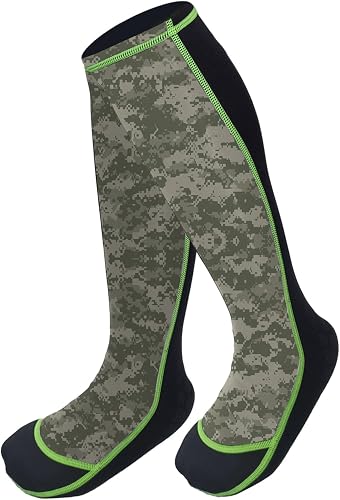
Best for: sliding smoothly inside waders without sticky rubber friction.
Riverruns builds these socks with three-layer neoprene to offer thermal insulation and breathability without a sultry feeling. The exterior fabric prevents the socks from sticking to the inside lining of your boots or wader booties. Flatlock stitching with high-strength nylon thread reinforces high-stress areas like the toe tips.
The sole features a snake-scale silicone print to generate grip against inner wader booties. However, the listing explicitly notes these socks aren’t directly waterproof on their own and need pairing with waders to stop cold water ingress. That makes them a poor match for an angler wanting a completely standalone barrier against wet feet.
Good if:
- You struggle to pull boots over rubbery wader booties.
- You need flatlock stitching that prevents hot spots.
- Your wet wading involves high-friction boots.
Skip it if:
- You want dry feet without wearing outer waders.
- You need a fold-down gravel guard with a lace hook.
3. XUKER 3.5mm Neoprene Guard Wading Socks Fast-Draining
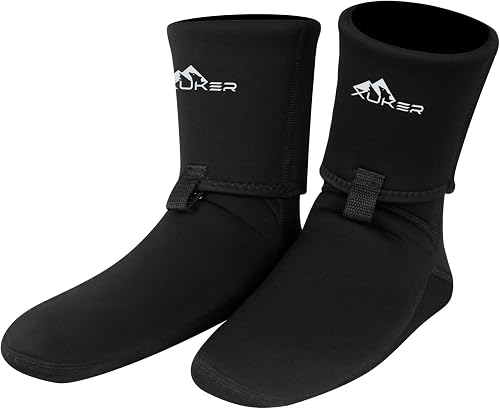
Best for: fast water drainage during warm summer wet wading trips.
At 3.5mm thick, these socks offer slightly thicker insulation against cold river currents while relying on a self-bailing system to dump water quickly. A fold-over gravel guard with a boot clip stops sand and small pebbles from packing down around your ankles. The pattern features vibrant mountain and fish graphics.
The universal left-right cut lets you pull them onto either foot without checking labels, saving time at the tailgate. Because the self-bailing design lets water flow through fast, it doesn’t try to keep feet completely dry. Anglers looking to trap a warm, static layer of water in freezing streams might prefer sealed seams.
Good if:
- You want your feet to empty quickly upon exiting rapids.
- Sand and pebbles routinely foul your laces.
- You prefer symmetrical socks that fit either foot.
Skip it if:
- You need sealed, watertight seams for icy runoff.
- You dislike loud graphic patterns on your gear.
4. Raprance Neoprene Wading Socks With perforat

Best for: warm-weather anglers who hate the clammy feel of solid neoprene.
Raprance uses perforated 3mm neoprene to let trapped water escape and allow skin to breathe during long days on the water. An anatomical shape hugs your foot tightly to eliminate bulk when you slip into wading shoes. An integrated rollover gravel guard covers your laces to block silt, grit, and loose river stones.
Four-way stretch material keeps natural movement free through the ankles, and the entire pair is machine washable for straightforward maintenance. The trade-off for all those drainage perforations is rapid water ingress, which won’t work for anglers wading cold tailraces who need solid insulation to trap body heat.
Good if:
- You wet-wade predominantly during hot summer afternoons.
- You want low-bulk socks that wash in a standard laundry cycle.
- River grit frequently packs into your shoelaces.
Skip it if:
- You fish freezing mountain streams in early spring.
- Your boots require heavy, thick padding to fill excess space.
5. STORMR Men’s Neoprene Waterproof Windproof Stretchy Fishing Socks

Best for: cold-water wading when keeping heat locked in is critical.
STORMR builds these socks with 3mm neoprene that uses glued and blind-stitched seams to prevent water seepage and block wind. Inside, a moisture-wicking micro-fleece lining sits against the skin to help keep your feet warm during extended outings. The screened bottom has a non-slip grip that holds traction on slick surfaces.
These design choices focus entirely on thermal retention and cushioning against the cold. Because there are no built-in gravel guards or drainage holes, any silt that comes over the top stays inside until you remove the sock, making them poorly suited for shallow gravel bars without gaiters.
Good if:
- You stand in frigid river water for several hours.
- You want a soft micro-fleece lining against your skin.
- You need glued and blind-stitched thermal seams.
Skip it if:
- You need gravel guards to shield open wading shoes.
- You wet-wade in hot conditions where drainage matters most.
6. King Mills Plus Size 3mm Neoprene Water Socks

Best for: anglers with large feet who struggle with standard unisex sizing.
Sizing for standard neoprene footwear often stops early, but King Mills cuts these socks for US men’s sizes 12 to 16 and women’s 13 to 17. The 3mm neoprene delivers abrasion resistance and thermal padding against underwater rocks. An integrated drainage system lets water clear out so you aren’t carrying extra weight between holes.
They provide reliable wet wading comfort across rocky beds, rafting trips, and snorkeling. Because they cater strictly to larger profiles, an angler with a standard or narrow shoe size will find too much bunched material inside a boot.
Good if:
- You wear men’s shoe size 12 through 16.
- You need roomy, abrasion-resistant wet wading booties.
- You require rapid drainage when stepping onto riverbanks.
Skip it if:
- You wear a standard medium or small shoe size.
- You need a dedicated lace clip for your boots.
7. OMGear Water Socks Neoprene Socks Beach Booties 3mm 5mm Anti-Slip
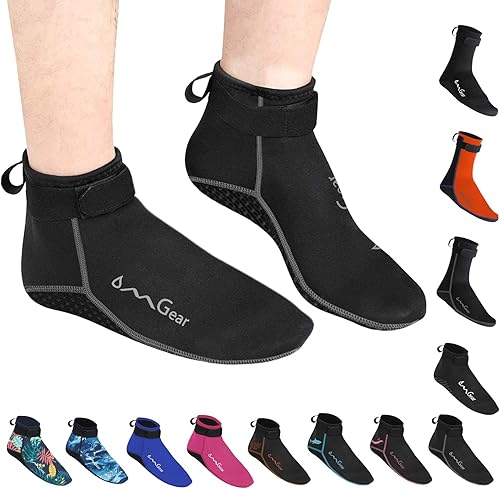
Best for: technical foot traction inside loose river shoes or on slick rocks.
These 3mm neoprene socks feature a rubber-printed, reinforced sole designed to resist tears while delivering strong anti-slip traction. An ankle strap adjusts tightly around the cuff to seal out sand and river debris, while a heel loop helps you pull them on quickly. The four-way stretch nylon laminate protects skin from scratches.
OMGear uses flatlock stitching, which breathes well for spring through autumn use but isn’t glued. That means water easily passes through the seam lines. If you’re wading in cold winter water where minimal water exchange is vital, this unglued stitch isn’t the right tool.
Good if:
- You need an adjustable ankle cuff to block sand.
- You want extra rubber grip across the bottom of the foot.
- You prefer flatlock stitching for warm-season wading.
Skip it if:
- You need glued seams to minimize water entry in winter.
- You require a fold-over flap to cover your boot laces.
8. Skyone Neoprene Water Fin Sock Diving Wetsuits Sock 3MM

Best for: high-flexibility wet wading without stiff foot fatigue.
Skyone builds these socks with 3mm premium neoprene boasting 150% high stretch and recovery, reducing tension around your foot. Glued and blind-stitched seams create a durable build that minimizes tearing along the joints. A textured hi-grip sole pattern offers traction across wet surfaces and river stones.
The flexible cut slips easily beneath regular wading booties or water shoes to add warmth in colder water. However, the upper cuff has no dedicated gravel guard or lace hook, so fine sand can still wash in over the top if your pants don’t cover your ankles.
Good if:
- You experience foot fatigue from stiff, restrictive neoprene.
- You want strong glued and blind-stitched seam durability.
- You plan to layer them inside roomier boots.
Skip it if:
- You fish rocky streams without external gravel guards.
- You have very wide feet that exceed typical stretch limits.
9. Waterproof Neoprene Crew Socks

Best for: multi-sport use requiring a traditional sock profile and sweat control.
Unlike pure neoprene booties, these crew socks feature a three-layer knit structure. The outer shell uses waterproof nylon and elastane, the middle layer is a waterproof PU membrane, and the inner lining uses 66% Coolmax to wick sweat away. Seamless toe closures and arch compression eliminate rubbing and bunching.
They protect against cold river splashes and damp boots just like hiking gear. But because they rely on an open elastic ribbed cuff, water will flood the sock immediately if you wade deeper than the collar, leaving the PU membrane holding water inside rather than letting it drain.
Good if:
- You hike long trail miles to reach your fishing spots.
- You want a Coolmax interior that wicks skin sweat.
- You need a standard sock profile without thick neoprene seams.
Skip it if:
- You regularly step into deep water above the sock cuff.
- You need drainage holes to dump trapped water immediately.
10. 3mm Anti-Slip Diving Booties

Best for: simple slip-on thermal protection across mixed water sports.
Dizokizo constructs these booties using 3mm neoprene with 4-way stretch nylon and glued blind stitching (GBS) to minimize water ingress. A textured, non-slip bottom provides insulation and stable stepping across damp riverbanks. The design offers straightforward protection from cuts, scratches, and cold river currents.
The listing notes that the sole uses a hard urethane rubber material, which is explicitly not suitable for rock climbing or walking on smooth boardwalks where hard rubber can slip. The ankle area may also allow minor water entry since it lacks a cinching strap or gravel flap.
Good if:
- You want basic, no-fuss 3mm insulation with sealed GBS seams.
- You need wear resistance against sharp underwater debris.
- You use them across kayaking, diving, and stream wading.
Skip it if:
- You frequently walk across slick wooden boardwalks or boat ramps.
- You need integrated gravel guards to shield boot laces.
Where These Overlap
Many of these socks share core raw materials, but their closure and drainage methods draw the real lines. The 8 Fans Neoprene Wading Socks, XUKER 3.5mm Guard Socks, and Raprance Perforated Wading Socks all feature fold-over gravel guards with boot hooks to manage stream grit. If you choose between those three, you’re only deciding between perforations for warm air flow or solid neoprene for cold pools. Meanwhile, simpler booties like Skyone 3mm Fin Socks and 3mm Anti-Slip Diving Booties rely on basic cuffs and glued seams. They fit tighter inside standard boots, but they won’t stop pebbles from packing around your laces.
Still Not Sure?
How often will I wet-wade in moving gravel?
If you routinely hike loose gravel beds or sandy streams, pebbles will work down into unshielded shoes within minutes. Choose a model with a built-in fold-over gravel guard and lace hook, like the 8 Fans Neoprene Wading Socks, rather than dealing with standalone gaiters.
What footwear do I plan to wear over them?
Traditional wading boots have room for 3mm rubber, but tight water shoes or snug trail runners won’t tolerate bulky seams. If your outer shoes fit close to your street size, go with the low-profile knit construction of the Waterproof Neoprene Crew Socks to avoid painful hot spots.
Am I fishing in summer heat or freezing tailraces?
Trapping water inside a thick bootie during a warm July afternoon leads to hot, clammy feet. If you only wade under a blazing summer sun and need rapid water exchange, pick the ventilated build of the Raprance Perforated Wading Socks instead of sealed cold-water neoprene.
Anglers fishing gravelly summer runs will get the best utility from the lightweight neoprene wading socks, while those facing frigid waters who need sealed seams should pick the STORMR Neoprene Fishing Socks. Check your wading boots to confirm how much internal room you have before making your choice.
Related guides
Frequently Asked Questions
How do I stop invasive river species when moving between waters?
You must inspect, clean, and dry your footwear before fishing new watersheds. The U.S. Fish and Wildlife Service advises washing off all visible mud, plants, and aquatic organisms to prevent spreading pests. Allow your neoprene socks to dry thoroughly before packing them for a different river system.
Also Worth Considering
The XUKER and nitescuba neoprene socks provide specialized options for beach sports, snorkeling, and kayaking by prioritizing sand defense and low-bulk fits. These designs offer versatile water protection for general recreation. Moving forward, evaluate your specific wading boot volume to ensure these socks provide the necessary comfort for your next trip.
Final Thoughts
Once you’ve picked a pair, don’t just toss them in your gear bag after a long day. Rinse them thoroughly with fresh water and let them air dry away from direct sunlight to keep the material flexible. You’ll find that a little extra care makes your next trip to the river much more comfortable.